
- Swedish employers reported a shortage of approximately 61,400 workers across different occupations in 2025, compared with 70,000 in 2024
- Healthcare, IT, engineering, construction and education are among the areas experiencing recruitment difficulties
- The largest individual occupational shortage reported by SCB was among ICT architects, systems analysts and test managers, with an estimated 4,000 missing workers
- Stockholm, Västra Götaland and Skåne accounted for approximately half of Sweden's reported labour shortage
- Northern Sweden also experiences recruitment difficulties, particularly in specialist industries and occupations
- A shortage of qualified workers does not automatically mean an easy route into employment for international applicants. Swedish-language requirements, professional qualifications and recognition of overseas credentials can all affect your prospects
most in demand occupations

new roots4 minutes

There continues to be a shortage of qualified workers across several regions and multiple industries, from healthcare and engineering to IT, construction and education. Discover where employers are struggling to recruit, which occupations offer the strongest prospects, and what internationals looking for work should know before submitting a job application.
Regardless of Sweden's diverse economy and demand for workers across professional, technical, industrial and public-service occupations, the availability of jobs and the availability of people with the right skills do not always match.
Statistics Sweden (SCB) reported that employers were short of approximately 61,400 workers across different occupations in 2025. This was down from approximately 70,000 in 2024, indicating a general reduction in reported labour shortages.
The figures cover a broad range of occupations, from jobs requiring advanced university qualifications to vocational and practical skills.
Importantly, SCB defines a labour shortage as work that is not being carried out despite an employer having the opportunity to recruit. This is different from simply counting advertised vacancies.
The distinction matters. An employer may have a vacancy that is successfully filled, while another may be unable to recruit enough suitably qualified people to complete the work required.
The statistics therefore provide an indication of where employers are experiencing difficulties finding the skills they need, rather than a direct count of available jobs.
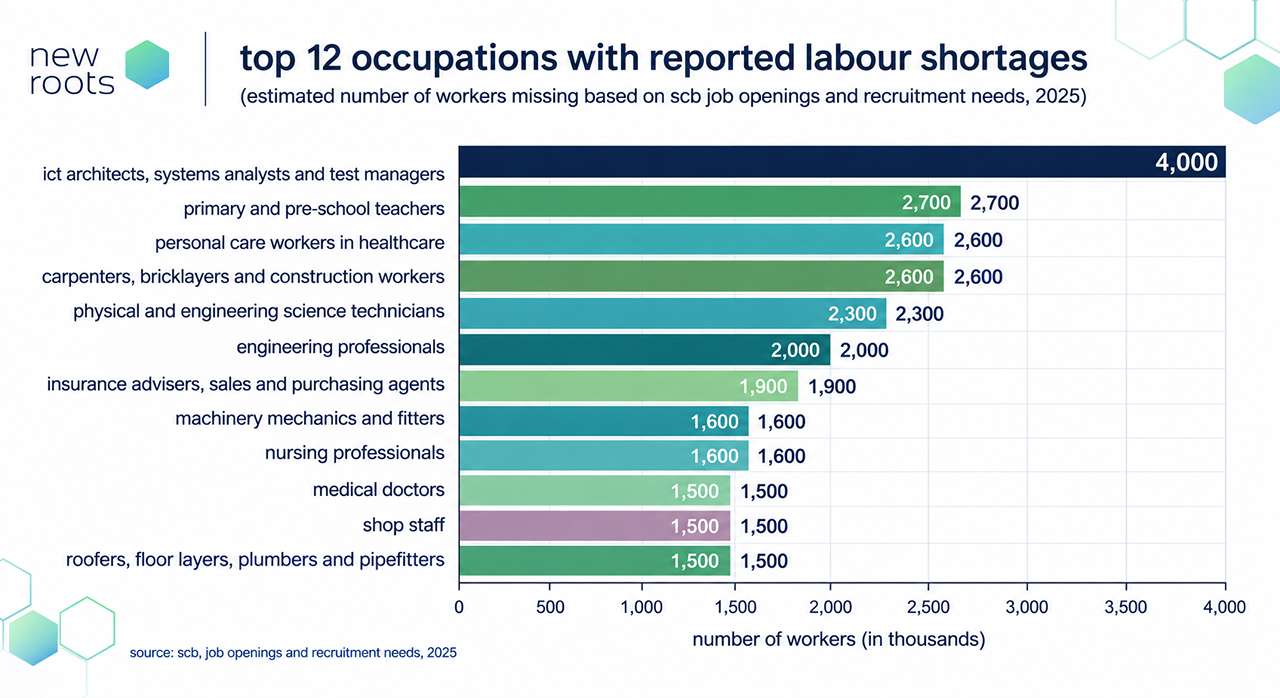
The above figures taken from SCB's 2025 recruitment-needs survey, represent the estimated number of workers employers were missing in each group.
These figures illustrate that labour shortages are not confined to highly specialised professional occupations. Sweden also needs people with practical vocational skills and experience in essential services.
Looking beyond individual job titles helps provide a clearer picture of where employment opportunities may exist.
Healthcare remains one of the areas with significant recruitment needs.
SCB reported shortages in several healthcare occupations during 2025, including:
- specialist doctors, particularly in areas such as psychiatry, anaesthesia, radiology and intensive care
- nurses, including specialist nurses
- assistant nurses (undersköterskor)
- other healthcare professionals and support workers
Of the shortage of around 1,500 doctors, around 1,400 were specialists. Employers also reported difficulties recruiting specialist nurses in several areas.
what this means for international jobseekers
Healthcare offers opportunities, but many occupations are regulated. Doctors, nurses and other licensed professionals generally need their qualifications assessed and approved by the relevant Swedish authority. Swedish-language proficiency is also an important consideration for patient-facing roles.

IT is another area where employers report shortages, particularly in specialist and technically demanding roles.
SCB identified a shortage of around 4,000 people among ICT architects, systems analysts and test managers. Software and systems developers accounted for a substantial part of this demand.
Other areas include:
- software and systems development
- IT architecture
- systems analysis
- cybersecurity
- IT operations and technical support
- network and infrastructure management
However, there is an important distinction between reported shortages and actual recruitment success.
Despite the reported shortage of IT professionals, 9 out of 10 employers that attempted to recruit in the relevant IT occupational groups said they always or often succeeded in finding candidates with the right qualifications.
This suggests that recruitment demand can exist without employers necessarily struggling to fill every position.
what this means for international jobseekers
IT can offer opportunities for people with relevant experience and specialist skills. Some technology companies operate primarily in English, particularly in larger cities, although more and more, Swedish is required or rather preferred for many positions.
Engineering and industrial technology are important parts of Sweden's economy, with recruitment needs across several specialist occupations.
SCB reported a shortage of approximately 4,300 engineers and technicians in 2025, particularly within mechanical engineering.
Areas of demand include:
- mechanical engineering
- electrical engineering
- industrial automation
- manufacturing technology
- maintenance and production engineering
- physical and engineering science technicians
Sweden's established industrial base, together with investments in energy, infrastructure and advanced manufacturing, creates demand for technical expertise.
what it means for international jobseekers
Engineers and technicians with relevant qualifications and practical industry experience may find opportunities across several regions. Employers may place particular importance on technical specialisation, industry experience and familiarity with Swedish workplace standards.
Construction and building-related occupations also feature prominently in SCB's shortage figures.
Employers reported recruitment needs among:
- carpenters
- bricklayers
- construction workers
- plumbers and pipefitters
- roofers
- floor layers
Heating, ventilation and air-conditioning technicians are also among the occupations where employers have experienced recruitment difficulties.
These roles often require vocational qualifications, practical experience and knowledge of Swedish building regulations and workplace safety requirements.
what it means for internationals
Skilled tradespeople may find opportunities, particularly where they have recognised qualifications and demonstrable experience. However, occupational certification, safety training and Swedish-language requirements can vary between employers and trades.
Sweden also reports recruitment needs across parts of its education system.
SCB identified a shortage of approximately 3,300 education professionals in 2025, including:
- 1,000 pre-school teachers
- 700 primary school teachers
- 1,000 recreation instructors
- 300 special education teachers and special needs teachers
Schools also reported difficulties recruiting vocational teachers in areas such as vehicle and transport education and building and construction.
However, recruitment conditions differ between teaching specialisations. SCB found that many employers were generally able to recruit pre-school teachers, primary school teachers for younger pupils and Swedish-language teachers.
what it means for internationals seeking jobs
Teaching can offer opportunities for people with relevant professional experience, but foreign teaching qualifications generally need to be assessed by the Swedish National Agency for Education (Skolverket). Swedish-language proficiency is particularly important in most school and childcare environments. However there are plenty of cases where a basic level of Swedish is proficient, especially for short-term contract teaching roles, teaching older children, and teaching certain subjects.
Labour shortages are not distributed evenly across the country.
SCB's regional analysis of 2025 recruitment needs found that approximately half of Sweden's reported labour shortage was concentrated in 3 major counties: Stockholm, Västra Götaland and Skåne.
what the figures tell us
Stockholm accounts for almost a quarter (24.8%) of Sweden's reported labour shortage, while Västra Götaland contributes 14.4% and Skåne 12.6%.
Together, Sweden's 3 largest metropolitan regions account for 51.8% of the reported shortage.
However, there is an important distinction: these percentages represent each county's share of the national estimated shortage, not the proportion of its own workforce that employers cannot recruit.
opportunities beyond the largest cities
Smaller cities and municipalities can also offer opportunities, particularly in specialist industries.
Examples include:
- Västerås: Electrical engineering, industrial automation, energy and advanced manufacturing
- Skövde: Automotive manufacturing, engineering and industrial production
- Jönköping: Manufacturing, logistics, warehousing and supply chain operations
- Sandviken: Steel production, materials technology and industrial engineering
- Luleå: Steel, mining, energy and industrial technology
- Kiruna and Gällivare: Mining, engineering and related technical occupations
- Skellefteå: Industrial manufacturing, energy and engineering
- Uppsala: Life sciences, pharmaceuticals, biotechnology and healthcare
The northern counties of Västerbotten and Norrbotten have also experienced recruitment difficulties in several occupations. However, major industrial investments and changing economic conditions mean that employment prospects can vary considerably between locations and sectors.
For international professionals, looking beyond the largest cities may reveal opportunities that are less obvious when searching only for jobs in Stockholm, Gothenburg and Malmö.
Source: SCB, Recruitment Experiences and Recruitment Needs by Occupation and Region, published 2 July 2026. Figures refer to 2025.
Current recruitment shortages provide one indication of where employers need workers today. Longer-term forecasts offer another perspective.
Arbetsförmedlingen (the Swedish Public Employment Service) publishes its Occupational Barometer (Yrkesbarometern), which assesses recruitment conditions and employment prospects across different occupations.
The barometer also forecasts how demand for workers in individual occupations is expected to develop over approximately 5 years.
The assessment is updated twice a year, generally in June and December.
Arbetsförmedlingen's June 2026 assessment is the latest available at the time of writing.
Its forecasts consider factors including employer recruitment needs, labour-market statistics, economic developments and demographic changes.
For international jobseekers, this is particularly useful because an occupation experiencing recruitment difficulties today may have different prospects in the future.
It is worth considering both the current assessment and the 5-year outlook when researching a potential career move.
A shortage of qualified workers does not automatically mean that an employer will recruit someone from abroad.
Several factors influence whether international applicants can successfully enter the Swedish labour market.
swedish-language requirements
Language requirements vary considerably between industries and employers.
Some international companies, particularly in technology, engineering and research, use English as their main working language.
However, Swedish is often required for roles involving patients, children, customers, public administration and communication with local authorities.
Learning Swedish can therefore expand the number of opportunities available, even in industries where English is widely used.
recognition of qualifications
Some occupations require Swedish recognition, registration or professional licensing.
This is particularly relevant to healthcare professionals, teachers and other regulated professions.
Depending on the occupation and your country of education, you may need to have your qualifications assessed, provide supporting documentation or complete additional education or practical training.
Before applying for positions, check the requirements for your particular profession.
experience and specialist skills
Employers experiencing recruitment difficulties are not necessarily looking for general experience.
They may be searching for specific technical knowledge, professional registration, industry experience or specialist qualifications.
For example, demand for engineers does not mean every engineering specialisation has the same employment prospects.
Understanding the specific skills employers are seeking can help you focus your job search more effectively.
location and flexibility
Job opportunities vary between regions and municipalities.
Being willing to consider employment outside the largest cities may open up additional possibilities, particularly in healthcare, manufacturing, engineering and specialist industrial sectors.
However, consider housing availability, commuting options and the practicalities of relocating before accepting a position.
understanding the statistics
- Labour shortage: the estimated number of workers employers say they are missing to carry out work they have the opportunity to undertake
- Job vacancies: positions employers are actively seeking to fill
- Recruitment difficulties: situations where employers experience problems finding suitable candidates (they may still succeed in filling the position)
- Occupational demand forecasts: assessments of how demand for workers in particular occupations is expected to develop over time (Arbetsförmedlingen publishes these through its Occupational Barometer)
- Unemployment: the proportion of the labour force without employment but actively seeking work and available to start (a shortage in one occupation can exist alongside high unemployment in another)
data note: Figures in this article refer to the stated reference periods and are based on official Swedish statistics available at the time of review. SCB's estimates are subject to statistical uncertainty. Occupational demand and recruitment conditions can change, so readers should consult the original sources for the latest assessments.
Statistics Sweden (SCB) – Official employment, labour-market and recruitment statistics
SCB – Job Openings and Recruitment Needs – Statistics on vacancies, recruitment experiences and occupational shortages
Arbetsförmedlingen – Occupational and Skills Analyses – Current and historical occupational assessments and 5-year forecasts
Arbetsförmedlingen – Find Occupations – Explore occupations and employment prospects
UHR – Swedish Council for Higher Education – Information about the assessment of foreign qualifications
Socialstyrelsen – Information about professional licensing and recognition for regulated healthcare occupations
Skolverket – Information about teaching qualifications and recognition
which jobs are most in demand?
Healthcare professionals, IT specialists, engineers, teachers, construction workers and skilled tradespeople are among the occupational groups experiencing recruitment shortages. However, demand varies by specialisation and region.
are there jobs for english speakers?
Yes. Some employers, particularly in technology, engineering, research and international business, recruit English-speaking professionals. However, Swedish is required for many occupations, particularly in healthcare, education, public services and customer-facing roles.
which regions have the greatest labour shortages?
Stockholm, Västra Götaland and Skåne accounted for approximately half of the reported labour shortage in 2025. Northern Sweden also experiences recruitment difficulties in several occupational areas.
does a shortage occupation guarantee a job?
No. Employers may require specific qualifications, relevant experience, professional registration and Swedish-language skills. A reported shortage indicates recruitment needs, not guaranteed employment for individual applicants.
where can I find out whether my occupation is in demand?
Arbetsförmedlingen's Occupational Barometer provides assessments of current employment prospects and recruitment conditions, together with 5-year forecasts. You can search for individual occupations and compare assessments across different regions.
do I need to have my foreign qualifications recognised before working in sweden?
It depends on your occupation. Regulated professions, including many healthcare and teaching roles, have specific recognition or licensing requirements. Other employers may assess overseas qualifications as part of their recruitment process.